

How Do You Get Your Website Cited in AI Overviews?
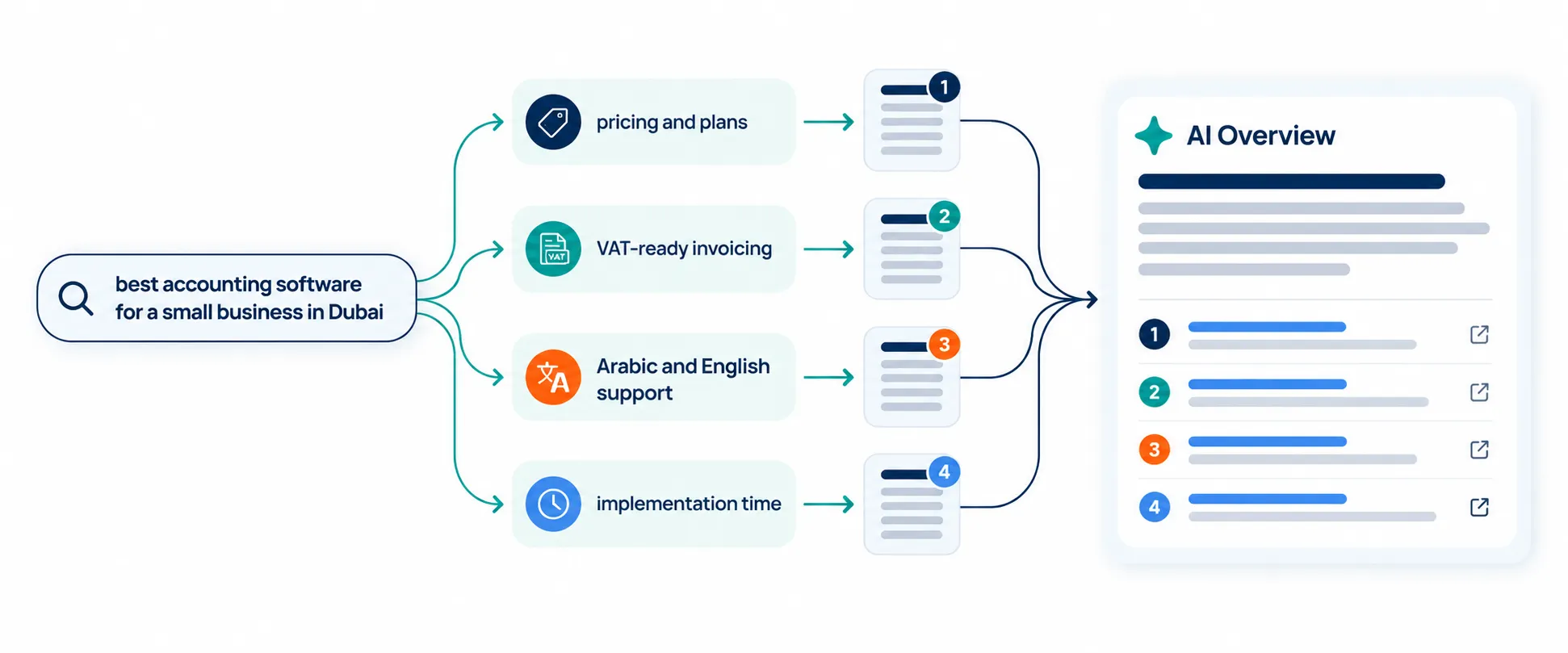
Earning a citation in Google’s AI Overviews depends less on where a page sits in the classic top ten and more on whether one passage on that page answers one specific question clearly. Google says AI Overviews and AI Mode can run a “query fan-out”, which means several related searches across subtopics, before they assemble an answer. Pages that answer those hidden sub-questions with direct, attributed, and well-structured passages are better placed to be linked. The practical work is content structure, verifiable proof points, accurate markup, and a brand presence beyond your own domain.
Key Takeaways
- Citations are no longer a top ten echo. In Ahrefs’ 2026 analysis of 863,000 keyword SERPs, about 38% of URLs cited in AI Overviews also appeared in the first ten SERP blocks. That is down from roughly 76% in Ahrefs’ July 2025 study.
- Query fan-out changes the unit of optimization. One search becomes several background searches, so a page needs to answer the sub-questions, not only the headline keyword.
- Answer first, then explain. A two-to-three sentence answer directly under each heading makes a passage easy to lift without surrounding context.
- Make facts easy to verify and easy to parse. Named sources, dates, first-party data, tables and numbered steps reduce ambiguity.
- Google’s own guidance is modest. Google states there are no extra technical requirements or special schema for AI features beyond being indexed and snippet-eligible, so treat structure and markup as clarity measures, not guaranteed levers.
- Your reputation off-site matters. Community platforms, video and third-party mentions feeding the same systems, and Ahrefs found YouTube mentions to be the factor most strongly correlated with AI Overview visibility in its 75,000-brand study.
Introduction:
Being cited in a Google AI Overview now matters for brand visibility, but the size of the opportunity is harder to pin down than many articles suggest. Google does not publish how often AI Overviews appear. Third-party trackers report very different numbers depending on their keyword sets: Conductor’s Q1 2026 benchmark of 21.9 million queries put prevalence at roughly 25%, while SEMrush and Similarweb data reported by Search Engine Roundtable on 30 July 2026 suggested about 48% and 43% of queries respectively. The honest summary is that AI Overviews are common; they vary heavily by topic, and your own priority queries are the only figures that matter for your business.
What is clearer is that the way sources are selected has changed. A page can rank first for a keyword and still be absent from the AI answer, while a page ranking far lower can be linked because one paragraph answers one sub-question well.
This guide explains how that selection works and what you can do about it. You will learn:
- What an AI Overview citation is
- Why AI Overviews visibility matters now
- Where AI Overviews pull citations from
- What makes a page citation-worthy
- Six practical steps to earn AI Overview citations
What Is an AI Overview Citation?
An AI Overview citation is a link to your page shown as a supporting source alongside Google’s AI-generated summary on the results page. A standard organic result presents your own title, URL and snippet, and the searcher chooses whether to click. A citation sits inside a synthesized answer, so the reader meets Google’s wording first and your page second, as a source they can open to learn more.
Google describes these links to help people find reliable information and explore beyond the summary. To be eligible, Google’s documentation says a page must be indexed and eligible to appear in Search with a snippet.
Why AI Overviews Visibility Matters Today
When an AI Overview appears, it occupies the most prominent space on the page, and that changes how people interact with results. Two findings pull in different directions, and both are worth knowing.
First, clicks to traditional results can fall. Pew Research Center’s July 2025 browsing study reported that users clicked a traditional result in roughly 8% of visits that included an AI summary, compared with roughly 15% of visits without one (figures to be re-checked against Pew before publication).
Second, Google states that clicks from results pages with AI Overviews tend to be higher quality, meaning visitors are more likely to spend longer on the site. Google has not published the data behind that statement, so it is best treated as the company’s position rather than an independent finding.
The practical conclusion is the same either way. If your content is not one of the sources an AI answer draws on, you are absent from a growing share of the first screen. Being cited gives you a place in it.
Where Do AI Overviews Actually Pull Citations From?
Many marketers assumed an AI Overview would simply summary the organic top ten. Recent data shows that is only partly true.
Ahrefs analyzed 863,000 keyword SERPs and about 4 million AI Overview URLs using its Brand Radar tool, with results published in March 2026. Looking at every block on the results page, including ads and SERP features, it found:
| Where the cited URL appeared in the same query’s SERP | Share of cited URLs |
| First 10 blocks | 37.9% |
| Positions 11 to 100 | 31.2% |
| Beyond position 100 | 31.0% |
In a second test limited to standard blue links, Ahrefs found 37.1% of cited URLs ranked in the organic top ten, 26.2% ranked 11 to 100, and 36.7% did not rank in the top 100.
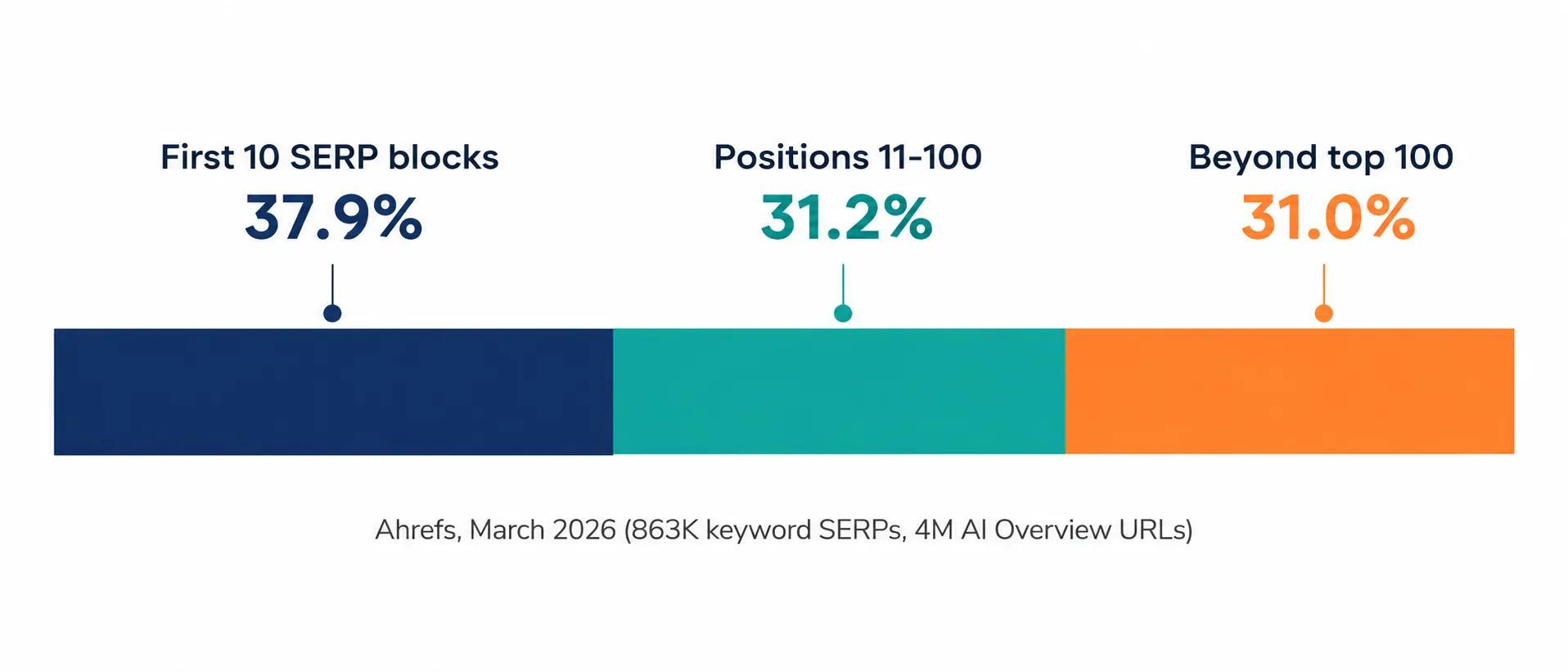
Source: Ahrefs
The comparison with the same publisher’s earlier work is the real story. In July 2025, Ahrefs found that about 76% of cited pages came from the top ten. Ahrefs suggests that the drop reflects heavier reliance on pages that surface for the related sub-queries rather than only the original query, and notes that AI Overviews have been powered by Gemini 3 since January 2026. That is a hypothesis from the researchers, not a confirmed mechanism, but it matches what Google’s own documentation says about query fan-out.
How Query Fan-Out Changes Source Selection
Google’s documentation says AI Overviews and AI Mode may issue multiple related searches across subtopics and data sources while building a response. A page that ranks modestly for the main query can still appear if it performs well for one of those hidden searches.
Which Platforms Appear Most Often
Beyond ordinary web pages, AI Overviews also cite forums, encyclopedias, news publishers and video. One vendor study, theStacc’s analysis of 1,000 US English desktop queries collected in April 2026, found an average of 4.2 citations per AI Overview, with a range of 2 to 9. It reported this distribution of citation share: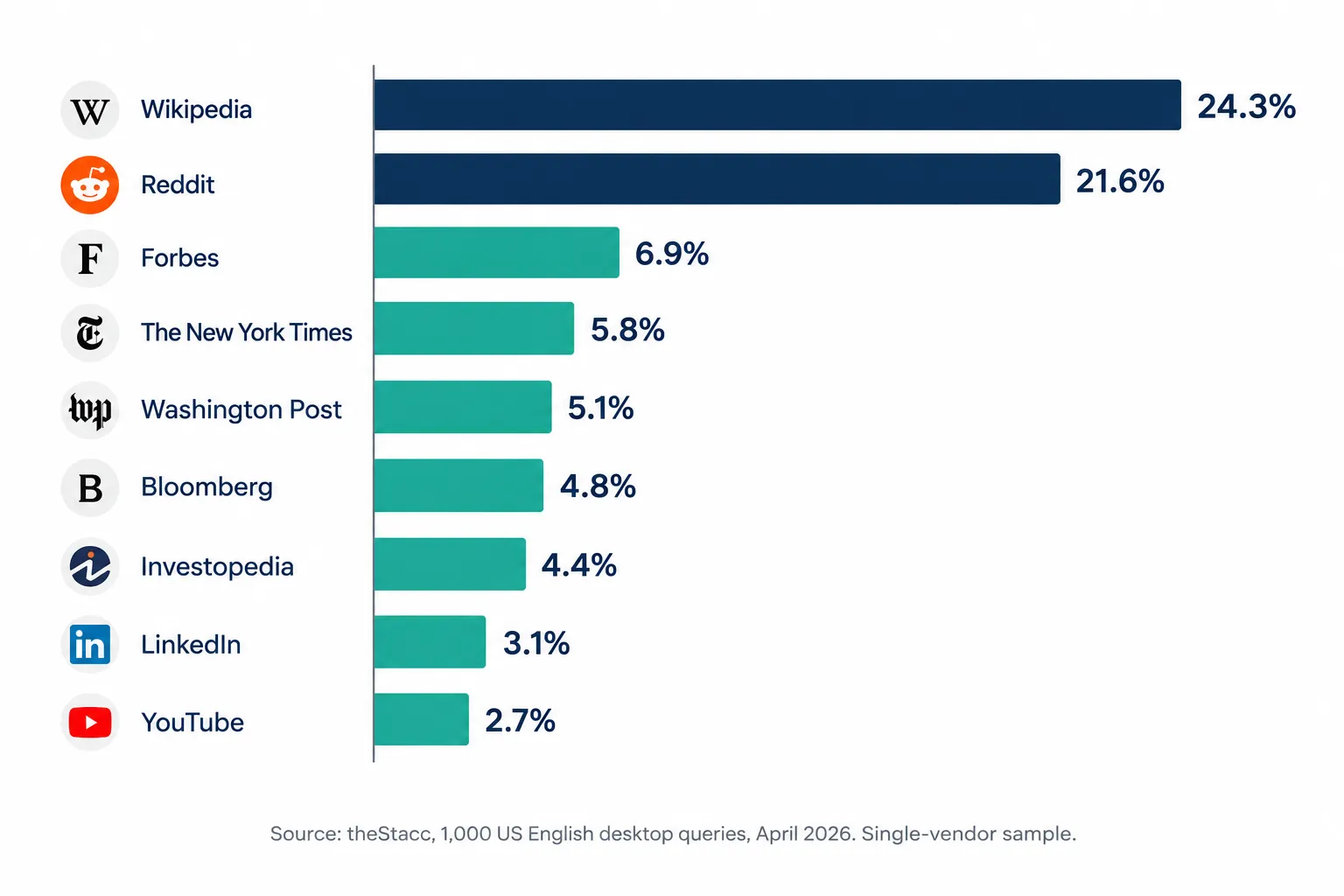
Source: AI Overviews Citation Sources Study
The takeaway for smaller sites is encouraging roughly a quarter of citations in this sample went to domains outside the named groups, which suggests a focused answer to a narrow sub-question can still win a slot.
What Makes a Page Get Cited in AI Overviews
If rankings do not decide citations, what does? Google’s documentation points to the fundamentals: people-first content, crawlable and indexable pages, important content in text form, and a good page experience. The studies below add observations about the pages that tend to be cited. Read them as correlations, not as ranking factors Google has confirmed.
Technical Signals
Structured data is a useful clarity tool, because it labels what a section represents in a form of software can read. theStacc reported that pages with schema markup were about 2.3 times more likely to be cited in its sample. Google’s position is more conservative: it says there is no special schema.org markup needed for AI features, and that any structured data should match the visible text. Implement markup because it describes your page accurately, not because it guarantees inclusion.
Content Length
theStacc found citation lift beginning at around 1,800 words, with pages over 2,500 words showing about 1.6 times the citations of pages under 800 words, levelling off near 3,500 words. Longer pages simply contain more passages to extract, and the same study noted length alone did not help without clear structure. Do not pad. Cover each sub-question properly and stop.
Information Structure
theStacc reported that around 44% of citations came from content in the first part of a page. The origin of that exact figure should be confirmed before it is quoted elsewhere, but the editorial logic holds: put the definition, the answer or the summary table early, then add depth.
Named-Source Attributions
In the same study, pages that named a source, a year and a specific claim had about 2.1 times the odds of citation compared with pages making unsourced assertions. Whatever the exact multiplier, attribution makes a claim checkable, and checkable claims are safer for an AI system to repeat.
Page Age and Trust Signals
theStacc reported a median cited-page age of 14 months, with 12 to 24 months showing the highest relative citation rate. Freshness appears to matter less than established, maintained pages, except for news-style queries. In practice, updating your best existing pages is likely to pay off more than publishing near-duplicates.
How to Get Cited in AI Overviews
Generative engine optimization (GEO) is the practice of structuring content so AI systems can find, understand, and attribute it. The six steps below turn the evidence above into a working process. Google’s guidance is clear that there is no secret switch, so the aim is to make each passage easy to retrieve, easy to verify, and easy to quote.
Step 1: Map Content to Query Fan-Out Intent
Traditional keyword work targets one phrase per page. Fan-out means the real competition is a cluster of related questions around that phrase, so the page should cover the journey, not just the head term.
- Collect the hidden questions. Check People Also Ask, related searches, forum threads, sales-call questions and the follow-ups in AI Mode or other AI assistants. Ahrefs notes that Google does not expose its own fan-out queries, and that AI answers vary from run to run, so look for recurring themes across many examples rather than trying to reproduce one exact expansion.
- Turn sub-questions into headings. Each distinct question becomes an H2 or H3 with its own self-contained answer.
- Cluster by topic, not keyword. Parent-topic and clustering features in SEO tools help you see which angles one page should own.
Here is an illustrative outline for a UAE tax page. The headings are examples of the approach, not verified search data:
| Heading level | Heading | Content under it |
| H1 | How to Register for Corporate Tax in the UAE | Short overview and who the page is for |
| H2 | Who Needs to Register? | Two-sentence direct answer, then a short eligibility list |
| H2 | What Documents Do You Need Before Applying? | Bulleted checklist |
| H2 | How Does the Registration Process Work Step by Step? | Numbered list, one step per line |
| H3 | What Happens After You Submit the Application? | Direct answer, then timing and next actions |
| H2 | Common Registration Mistakes and How to Avoid Them | Table of mistake, consequence and fix |
| H2 | When Should You Speak to an Adviser? | Short decision criteria |
Before publishing a page like this, confirm every regulatory detail against the official authority’s current guidance.
Step 2: Implement Answer-First Formatting
Passage-level retrieval rewards sections that make sense on their own. The journalistic “bottom line up front” approach does this naturally: lead with the answer, then support it.
- Open every H2 and H3 with a two-to-three sentence answer. No warm-up, no restating the question.
- Make each section stand alone. Name the subject explicitly instead of writing “this” or “it” across a heading boundary, so an extracted passage still makes sense.
- Keep the depth below the answer. Examples, caveats, and data follow the summary.
A weak opening: “There are lots of things to think about when it comes to schema, and many businesses are unsure where to begin.”
A stronger opening: “Start with Article, Organization and Breadcrumb List markup.” They describe who published the page, what it is and where it sits on your site, and they must match the visible text.”
Step 3: Package Data for Machine Readability
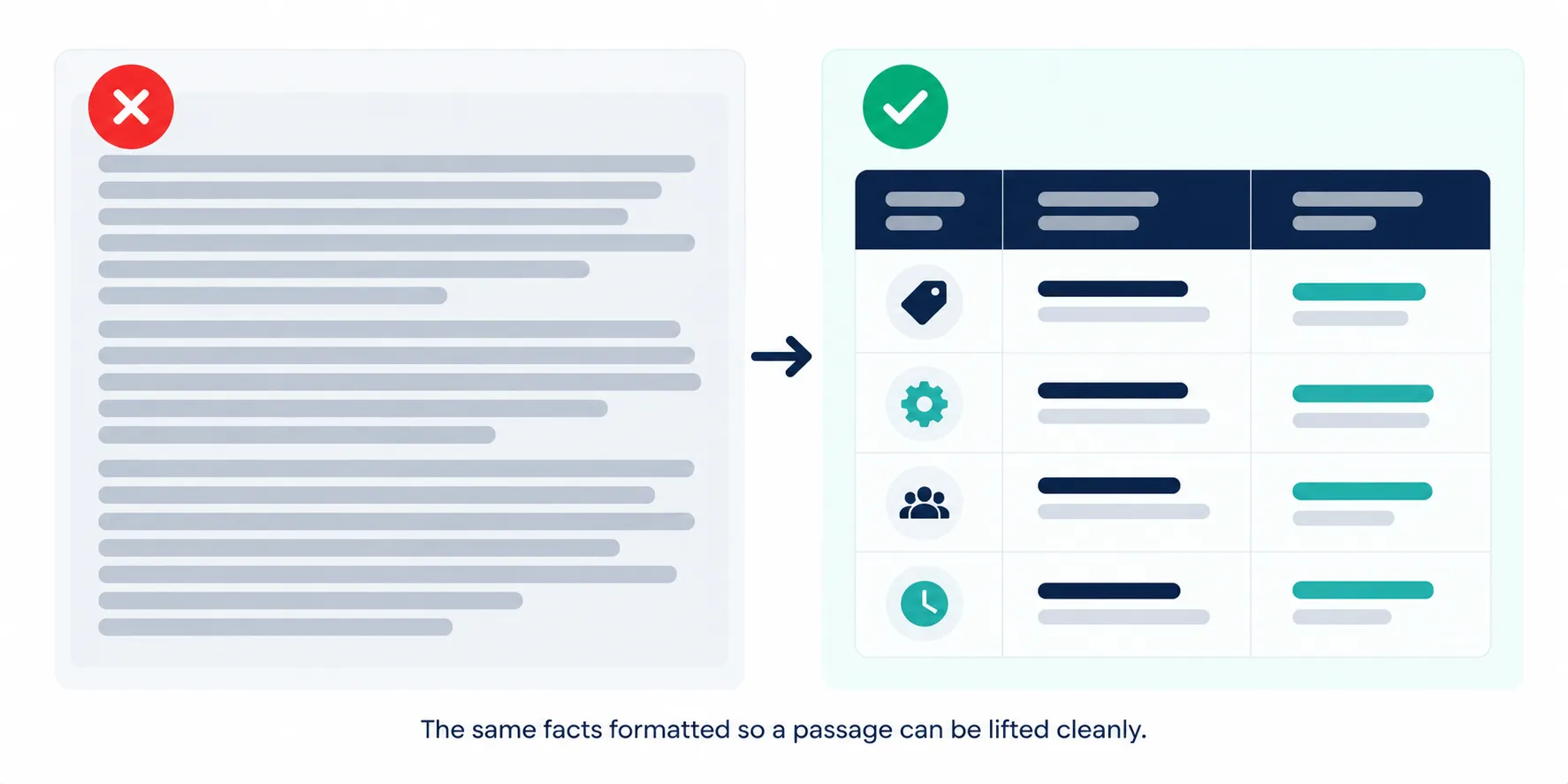
Software extracts structured layouts more reliably than dense paragraphs, and readers scan them faster too.
- Use tables for comparisons. Pricing tiers, specifications, and feature differences belong to a table with clear column headings.
- Use numbered lists for sequences and bullet lists for items with no order.
- Keep one idea per sentence and define terms for first use.
- Write real text, not images of text. Google lists making important content available in textual form among its basic recommendations.
Example: instead of three paragraphs on software plans, give a table with plan name, monthly price, user limit and one notable restriction, followed by a sentence explaining who each plan suits.
Step 4: Add Verification Anchors and Primary Data
An AI answer repeats claims, so claims that can be traced are safer sources. Place proof next to the point it supports.
- Attribute inline. Name the publisher, the year, and the specific finding in the same sentence, for example: “Ahrefs’ March 2026 analysis of 863,000 SERPs found about 38% of cited URLs also ranked in the first ten blocks.”
- Publish first-party evidence. Survey results, benchmark data, case-study metrics, and anonymized client trends are material nobody else can supply.
- Show who is speaking. Add author bylines with real credentials and attribute quotes to named experts with their roles.
- Date and maintain. Show last updated dates honestly and refresh figures for that age.
Step 5: Use Relevant Structured Data and Schema Markup
Structured data gives crawlers an explicit description of the page. Google is explicit that no special schema is required for AI features, and that markup must match what is visible on the page, so use it as accurate labelling.
| Schema type | Where to use it | Why it helps |
| Article or Blog Posting | Blog posts and guides | Declares headline, author, dates and publisher |
| Organization | Home and about pages | Clarifies who you are and links your official profiles |
| Person | Author pages | Connects content to a named, credentialed author |
| Breadcrumb List | Site-wide | Shows where the page sits in your structure |
| Product and Offer | Product pages | Describes price, availability and variants; keep in sync with Merchant Center |
| FAQ Page | Pages with visible Q&A | Describes the questions on the page; do not expect rich-result display on most sites |
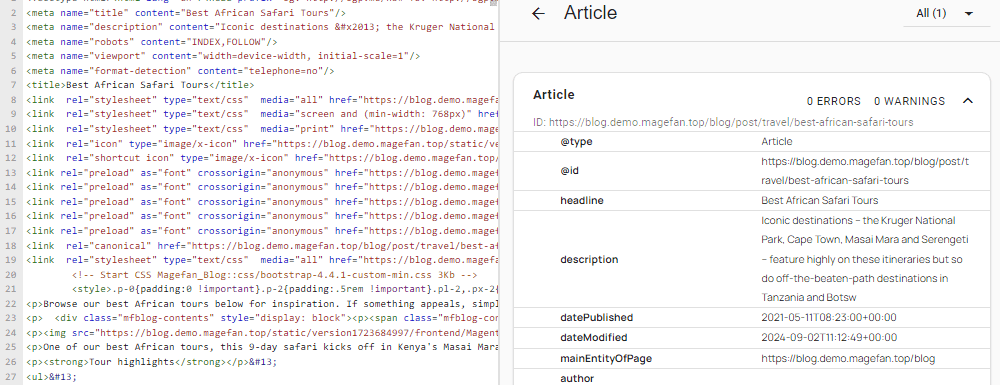
A minimal example for this article (replace every placeholder with real values and validate it before release):
{
“@context”: “https://schema.org“,
“@type”: “BlogPosting”,
“headline”: “How Do You Get Your Website Cited in AI Overviews?”,
“datePublished”: “[YYYY-MM-DD]”,
“dateModified”: “[YYYY-MM-DD]”,
“author”: {“@type”: “Person”, “name”: “[Author name]”, “url”: “[author page URL]” },
“publisher”: {“@type”: “Organization”, “name”: “[Brand]”, “url”: “[home URL]” },
“mainEntityOfPage”: “[canonical URL]”,
“image”: “[featured image URL]”
}
Source: Schema Example
Step 6: Expand Off-Page Brand and Entity Mentions
AI answers draw on the wider web, so your presence outside your own domain feeds retrieval. Ahrefs’ study of 75,000 brands found YouTube mentions in titles, transcripts and descriptions to be the strongest correlating factor with AI Overview visibility, which is a correlation and not proof of cause.
- Build a genuine presence where questions are asked. Contribute useful answers to communities such as Reddit and Quora, following each platform’s rules and disclosing your affiliation. Promotional posting tends to backfire.
- Publish video that answers real questions. Add accurate titles, descriptions, and transcripts. Ahrefs found YouTube accounted for 18.2% of cited pages that did not rank in the top 100.
- Earn third party mentions. Digital PR, expert commentary and industry features create the brand and topic associations that reinforce entity understanding, with or without a link.
- Keep entities consistent. Use the same business name, address, descriptions and leadership details across your site, Google Business Profile, directories, and social profiles.
Final Thoughts: The Path Forward in AI-First Search
Search is moving from a list of links to a synthesized answer with links attached. In that environment, the pages that win are not necessarily the strongest by traditional measures, but the clearest: those that answer a specific question directly, back it with named evidence, and present it in a form that is easy to parse.
That also happens to be good content. Google’s guidance remains that the foundations (indexable pages, helpful and reliable content, a good experience) are what counts, and nothing in the research above contradicts it. What has changed is how precisely those foundations are tested, passage by passage.
Start small. Pick up ten priority queries, check which sources currently appear in their AI Overviews, and restructure your best-matching pages against the six steps. Measure again after a few weeks, and expect results to vary, because AI answers change frequently, and no tactic guarantees a citation.
Maximize Your Website AI Visibility
If AI search is becoming part of how customers find you, a structured plan helps. KKonect Us Agency supports businesses with AI search optimization, from mapping query fanouts and restructuring content to implementing accurate structured data and building brand presence beyond your own site.
Talk to our team about an AI visibility audit for your website.
Frequently Asked Questions About AI Overviews Visibility
How can businesses measure their visibility in AI Overviews?
Combine three sources. Google Search Console includes AI feature appearances in its overall Web performance data, but it does not provide a separate AI Overviews report. Analytics platforms show the quality of traffic and conversions from organic search. Third-party AI visibility trackers monitor chosen queries over time for citations, competing sources and share of voice. Compare all three, because each captures a different part of the picture.
How does keyword research change when you optimize AI Overviews?
You research topics and question clusters rather than single phrases. Because Google may run several related searches for one query, list the sub-questions around each topic, rank them by business relevance, and give each one a clearly headed, self-contained answer.
How can I tell whether my website is visible in AI-generated results?
Track three measures across a fixed set of target queries: trigger rate (how many queries show an AI Overview), citation rate (how often your domain is cited when one appears), and URL spread (how many different pages earn citations). Re-run the checks on a regular schedule and note the date, since results change.
Why do lower-ranking pages get cited in AI Overviews?
Selection works at passage level and draws on related sub-queries as well as the original one. A lower-ranking page with a clearer, better-supported answer to a sub-question can be linked even when stronger pages hold the top organic positions. Ahrefs found nearly a third of cited URLs in its sample did not rank in the top 100 for the original query.
Which non-website assets contribute most to AI citations?
Video is the standout. Ahrefs identifies YouTube as the most cited domain in AI Overviews, and discussion platforms and encyclopedic sites also appear heavily in vendor studies. Optimize video titles, descriptions, and transcripts, and keep your presence on community platforms useful and honest.
How should ecommerce brand’s structure product data?
Keep product pages and feeds complete and consistent: accurate names, descriptions, attributes such as size and material, price and availability. Google advises keeping Merchant Center information up to date and making sure structured data matches the visible page. Use Product and Offer markup where it genuinely describes the page.
What should B2B companies change for multi-stakeholder buying journeys?
B2B buyers ask finance, security, technical, and implementation questions in the same research session. Build connected content that answers each stakeholder’s questions under clear headings, and link related pages together, so the whole journey is covered with consistent, attributed information.
Which external platforms influence AI citations the most?
In the studies cited here: YouTube (Ahrefs), and Wikipedia and Reddit (theStacc’s single-vendor sample), alongside news and specialist reference sites. You cannot control these platforms, but you can contribute accurately and ensure your brand details are correct wherever you appear.