

SEO in 2026 is no longer about ranking for keywords alone.
Search engines powered by large language models now interpret intent, summarize answers, and prioritize authority over keyword density.
To stay competitive, brands must optimize for AI Overviews, zero-click visibility, structured data, brand credibility, conversational search, and multi-format discovery.
The future of SEO belongs to businesses that combine technical precision, human expertise, and intelligent AI integration.
Search now operates on intelligence, not indexing alone.
Large Language Models (LLMs), AI assistants, and generative search layers sit between users and traditional search results. Instead of clicking through multiple websites, users increasingly receive direct, synthesized answers within the search interface.
Traditional SEO elements still matter:
But they are no longer enough.
Today, visibility depends on:
Search engines evaluate how well your content satisfies intent, how trustworthy your brand is, and how optimized your technical setup is.
Core ranking factors now include:
SEO has evolved from keyword engineering → authority engineering.
The Shifting Paradigm: From Keywords to Holistic Authority
Keywords remain relevant, but they are no longer the strategic center. Modern search engines analyze relationships between concepts, entities, and user context. Exact-match targeting has been replaced by semantic understanding.
Search systems now evaluate how topics connect across your website. A single page is not assessed independently. It is interpreted within a broader topical ecosystem.
This means depth matters more than repetition. Relevance outweighs density. Authority builds across clusters, not isolated posts.
SEO in 2026 is about constructing a coherent knowledge framework that search engines can interpret confidently.
Why These Strategies Matter for Long-Term Growth
AI-driven summaries increasingly determine what users see before they click. If your brand is not included in AI Overviews or enhanced search modules, you are losing visibility at the earliest stage of the user journey.
Modern SEO requires alignment between user psychology, AI extraction behavior, analytics insights, and technical architecture. Platforms like Google Search Console are no longer used only for tracking rankings, but also for monitoring visibility patterns, rich result inclusion, and engagement performance.
Future-proof SEO means designing content for AI extraction without sacrificing human trust.
Key SEO Trends in 2026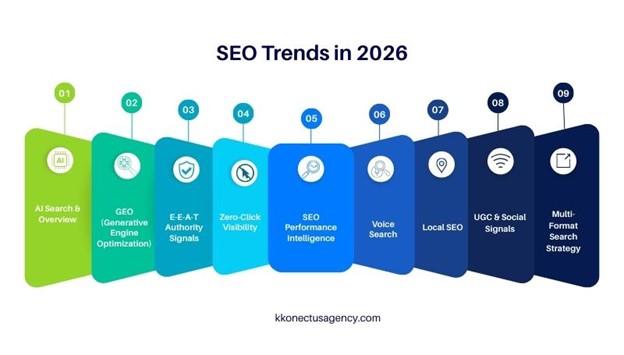
AI-generated summaries are now appearing across a significant percentage of informational queries, particularly in B2B, SaaS, health, finance, and educational topics. Studies in late 2025 showed that AI Overviews are triggered most frequently for long-form, research-driven queries rather than transactional ones.
This has directly impacted click-through rates. Informational keywords have seen noticeable CTR compression because users receive summarized responses directly in the SERP.
What does this mean for 2026?
Brands that structure definitions, processes, and comparisons clearly are more frequently extracted by AI models. Cluttered introductions and vague commentary are being skipped.
AI visibility is now a measurable performance layer.
Generative Engine Optimization has emerged because AI systems do not “rank” pages the way traditional search does. They select and synthesize.
In 2026, GEO focuses on:
AI models rely heavily on contextual signals. Pages that clearly define terms, connect related concepts, and provide layered explanations perform better in generative results.
Data from enterprise SEO tracking platforms shows that content with well-structured subheadings and concise answer blocks is more likely to be referenced by AI systems than long, unstructured text.
GEO is not replacing SEO. It is expanding it.
Google’s continued emphasis on experience and credibility has intensified as AI-generated misinformation becomes more widespread.
In 2026, search engines will be better at identifying:
Websites that publish anonymous, generic content are seeing more volatility. Meanwhile, brands with consistent authorship, industry recognition, and external mentions show greater ranking stability.
Case studies, original data, expert commentary, and documented experience significantly strengthen trust signals.
Authority compounds. Thin content erodes.
Recent industry tracking reports show that zero-click searches continue to represent a large share of informational queries. While the exact percentage fluctuates by industry, the broader pattern remains clear: more answers are delivered directly in the SERP.
But here’s the shift.
Zero-click does not equal zero value.
Brand recall increases when users repeatedly see a brand cited inside AI answers or rich snippets. Presence builds familiarity. Familiarity builds trust.
In 2026, leading SEO teams track:
SEO success is evolving from click acquisition to authority positioning.
Traditional metrics like keyword rankings and organic traffic are incomplete indicators of SEO health.
Modern performance evaluation includes:
Enterprise brands are increasingly monitoring how organic visibility supports assisted conversions rather than last-click conversions.
In 2026, SEO reporting dashboards look very different from five years ago. Visibility, engagement quality, and brand amplification matter more than raw impressions alone.
Voice and conversational interfaces continue expanding due to AI assistants embedded in browsers, smartphones, and workplace tools.
Search queries are longer and more natural. Instead of typing “best CRM software 2026,” users ask:
“What’s the best CRM for a small B2B SaaS company?”
Content that mirrors conversational phrasing performs better in these environments. Direct answers placed immediately after question-style headings increase eligibility for voice extraction.
Readability also plays a role. Simpler language improves AI interpretation accuracy.
Conversational search is less about volume and more about precision.
Search results in 2026 are heavily influenced by contextual factors such as:
Two users entering the same query may receive different results based on their prior interactions.
Local SEO has therefore become more sophisticated. Beyond listing optimization, businesses must maintain:
Personalization is reshaping how visibility is distributed across markets.
User-generated content is increasingly visible in search results. Platforms like Reddit, community forums, and review aggregators frequently appear on page one for product-related queries.
Search engines recognize that authentic user discussions reflect real-world validation.
In 2026, SEO strategies increasingly incorporate:
Trust is no longer built only on backlinks. It is reinforced by public sentiment and visible engagement.
Search behavior is now distributed across:
Video consumption continues growing, especially for how-to, product comparison, and educational queries. Short-form content influences brand discovery before traditional search even begins.
Optimizing across multiple content formats strengthens topical authority signals and increases visibility surface area.
Brands that rely solely on blog publishing are limiting their discoverability.
Measuring Modern SEO Performance
Rank tracking alone no longer defines success. Modern performance measurement includes AI visibility, citation frequency, engagement depth, brand mentions, and cross-platform impressions.
Scroll behavior, repeat visits, and interaction metrics reveal whether content satisfies user intent. Monitoring featured snippets and AI inclusion demonstrates authority growth.
Visual and video analytics should also be incorporated as multi-format search expands.
SEO success in 2026 is measured through presence, perception, and performance combined.
Key SEO Strategies for 2026
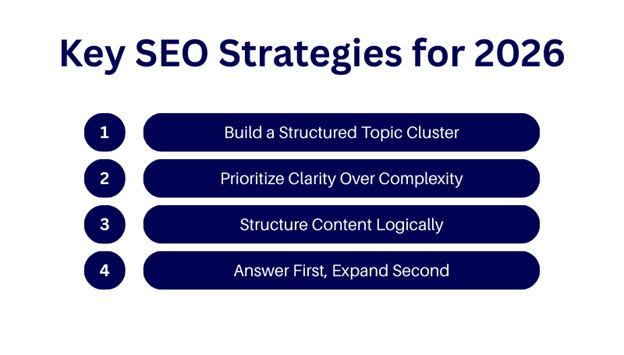
Isolated posts weaken authority. Develop interconnected content hubs built around core themes. Create comprehensive pillar resources supported by detailed subtopics linked strategically.
This structure strengthens semantic relevance and signals subject mastery to search engines and AI systems.
Both AI models and human readers prefer clarity. Avoid unnecessary jargon and filler. Explain concepts directly without sacrificing depth.
Clear writing increases the probability of inclusion in AI summaries and featured results.
Each section should focus on one defined concept and develop it fully. Logical progression enhances contextual understanding and extractability.
Clear hierarchies and consistent formatting improve both user comprehension and ranking stability.
Start with a concise response to the core question. Then expand with examples, explanations, and data.
This format aligns with featured snippet patterns, AI Overviews, and conversational search behavior.
What SEO Performance Tools Should You Use?
Monitor impression trends, rich result appearances, and evolving SERP features. Visibility shifts often signal alignment with AI-generated modules.
Measure scroll depth, time on page, and repeat interactions. Engagement reflects content relevance more accurately than traffic alone.
Track presence in featured snippets, AI summaries, and knowledge panels. Inclusion indicates authority positioning even when click volume changes.
Monitor image impressions, video engagement, and Discover visibility. Multi-format exposure now contributes significantly to organic performance.
The Future of SEO Trends in 2026
The future of SEO can be described as intelligence optimization. Rankings alone are no longer the primary objective. Trust, clarity, usability, and structured credibility define sustainable visibility.
AI systems reward content that educates, solves problems, and demonstrates expertise. Websites that consistently publish accurate, well-structured, and updated information are more likely to be referenced in AI-driven results.
Adaptability remains the strongest competitive advantage. Search engines will evolve. AI models will refine interpretation. User expectations will rise.
SEO success moving forward will depend on one principle: being understood and trusted at scale.
Perfect. I’ve consolidated your list, removed overlap, strengthened intent, and crafted 8 high-impact FAQs that combine strategic depth, snippet potential, and strong semantic coverage for “SEO Trends & Strategies You Must Follow in 2026.”
The most important SEO trends in 2026 include AI-driven search experiences, Generative Engine Optimization (GEO), zero-click visibility, conversational search optimization, experience-based authority (E-E-A-T), multi-modal content strategies, structured data implementation, and performance-focused technical SEO. Success now depends on clarity, credibility, and cross-platform presence rather than keyword density alone.
AI has transformed search engines into answer engines. Instead of listing links, search platforms now summarize and synthesize information using large language models. This means content must be structured, authoritative, and easy to extract to appear in AI Overviews. SEO now prioritizes intent alignment, semantic relationships, and trust signals over basic keyword matching.
Yes, but it has evolved. Core elements such as technical optimization, internal linking, keyword research, and content quality remain essential. However, they must now integrate with AI optimization, structured data, brand authority, and user experience signals. Traditional SEO foundations still matter, but they are no longer sufficient on their own.
AI Overviews often reduce direct clicks for informational queries because users receive summarized answers immediately. However, being cited within AI summaries increases brand visibility and authority. Businesses must shift focus from traffic-only metrics to presence and citation visibility within AI-generated search results.
Websites should provide direct answers at the beginning of sections, use clear headings, implement structured data schema, maintain strong E-E-A-T signals, and organize content logically. Including FAQ sections, concise definitions, and well-structured explanations improves the likelihood of being extracted and cited by AI systems.
Structured data helps search engines and AI systems understand content context more accurately. Schema markup enables eligibility for rich results, featured snippets, FAQs, product enhancements, and AI extraction. Proper implementation improves visibility across enhanced SERP features and increases the chances of appearing in zero-click environments.
User experience directly influences engagement metrics such as time on page, scroll depth, and return visits. Search engines use these signals to evaluate content relevance and quality. Core Web Vitals, mobile responsiveness, logical navigation, and clean structure contribute to both ranking stability and AI interpretability.
Yes, when executed properly. AI can accelerate research, structure outlines, and identify semantic gaps. Human experts add credibility, real-world experience, nuance, and fact-checking. A hybrid workflow combines efficiency with authority, producing content that performs well in AI-driven search environments while maintaining trust.
